Introduction
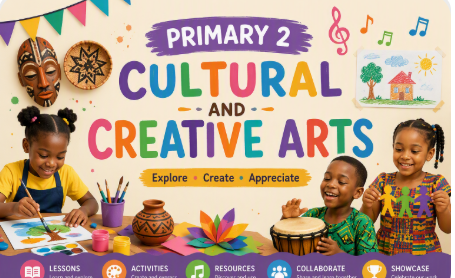
Cultural and Creative Arts at the Primary 2 level introduces pupils to the rich cultural heritage and creative expressions of their families, communities, and Nigeria. The subject provides opportunities for pupils to explore drawing, colouring, painting, crafts, music, drama, dance, and other creative activities. It helps children develop imagination, creativity, observation, self-expression, and appreciation of beauty and culture. Through practical activities, stories, songs, demonstrations, and simple projects, pupils learn to appreciate their own culture and respect the cultures of other people while developing useful artistic and creative skills.
General Objectives
By the end of Primary 2, pupils should be able to:
- Identify and describe simple forms of Nigerian arts and cultural activities.
- Develop basic skills in drawing, colouring, painting, and paper crafts.
- Identify and use simple lines, shapes, colours, and patterns in creative activities.
- Create simple artworks using locally available materials.
- Identify common musical instruments and describe their uses.
- Sing simple Nigerian songs, school songs, folk songs, and children’s songs.
- Demonstrate simple rhythms, movements, and dances.
- Participate in simple drama, role-play, and storytelling activities.
- Identify and appreciate traditional clothing, food, festivals, music, dances, and crafts.
- Develop creativity, imagination, confidence, and self-expression through artistic activities.
- Appreciate the importance of Nigerian culture and cultural heritage.
- Demonstrate respect for the cultures and creative expressions of other people.
- Work cooperatively with others during art, music, drama, and craft activities.
- Develop proper attitudes towards caring for and preserving artworks and cultural materials.
- Use creative activities to express ideas, feelings, experiences, and observations.
- Teacher: Nuhu Ishaya